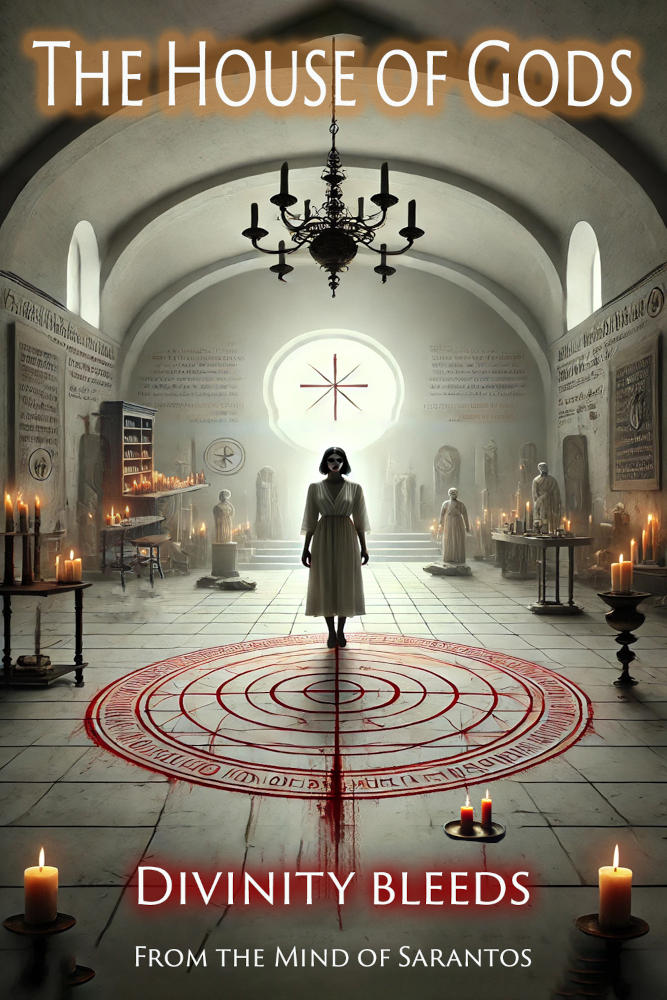
Logline:
In a remote Greek village where one family is said to carry the blood of the gods — descendants of Zeus himself — a skeptical anthropologist returns home for her mother’s funeral and discovers her father’s secret experiment to prove divinity through blood. As science and myth blur into ritual, she becomes the final subject in his search for resurrection — forced to confront whether the Gods ever died, or if they’ve simply been waiting inside her veins.
Awards



Concept
Set in an isolated Greek mountain village where one family is said to carry the blood of the Gods — descendants of Zeus himself — The House of Gods follows Eleni, a skeptical anthropologist who returns home for her mother’s funeral and discovers her father’s secret experiment to prove the existence of divinity through human blood. As his scientific pursuit devolves into ritual and resurrection, Eleni becomes both witness and vessel in a chilling collision of myth and reason — a haunting exploration of faith, inheritance, and the terrifying possibility that the gods never died… they evolved.
Central Theme
The central theme of The House of Gods is the corruption of faith through the pursuit of proof — the idea that the human need for certainty can turn both science and belief into acts of worship.
It examines how knowledge and devotion mirror each other: that faith without questioning becomes fanaticism, and science without humility becomes its own religion. Blood, in this story, is both data and inheritance — a living archive of belief that refuses to be dissected or denied.
At its core, the film asks: What happens when our need to understand the divine becomes the very thing that destroys it?


Genre: Psychological Thriller / Supernatural Drama
Subgenres:
Why This Fits:
In Studio Terms:
If you pitched it to studios or streaming platforms, you’d call it:
“A psychological folk-horror thriller where Ex Machina meets The Wailing — a haunting exploration of science as faith and divinity as contagion.”
Or simply:
“Prestige Psychological Thriller with mythic and biopunk horror elements.”
Synopsis
Eleni Hatzis, a brilliant but emotionally detached anthropologist, returns to her family’s remote Greek mountain village for her mother’s funeral — only to uncover her father’s secret project: an experiment designed to scientifically prove the existence of the Gods through human blood. The villagers believe their lineage descends from Zeus himself, and Dimitrios Hatzis, her father, intends to measure that divinity — no matter the cost.
What begins as academic curiosity spirals into obsession as Dimitrios’ experiments blur into ritual and resurrection. Eleni tries to expose him, but each act of defiance only draws her deeper into the experiment — until her own pulse begins to mirror the subjects she’s studying. When a young girl, Maria, is revived in a public ritual that shakes the village, Eleni becomes both witness and vessel in her father’s final trial: a merging of faith, science, and sacrifice that threatens to consume them all.
As the estate transforms into a temple of worship and Dimitrios’ proof edges toward apocalypse, Eleni must decide whether to destroy his creation — or embrace the terrifying possibility that divinity was never lost, only waiting to be rediscovered in human veins. The House of Gods is a chilling, cerebral thriller where faith becomes experiment, the dead refuse to stay silent, and the line between observer and deity disappears.
Ad Concepts
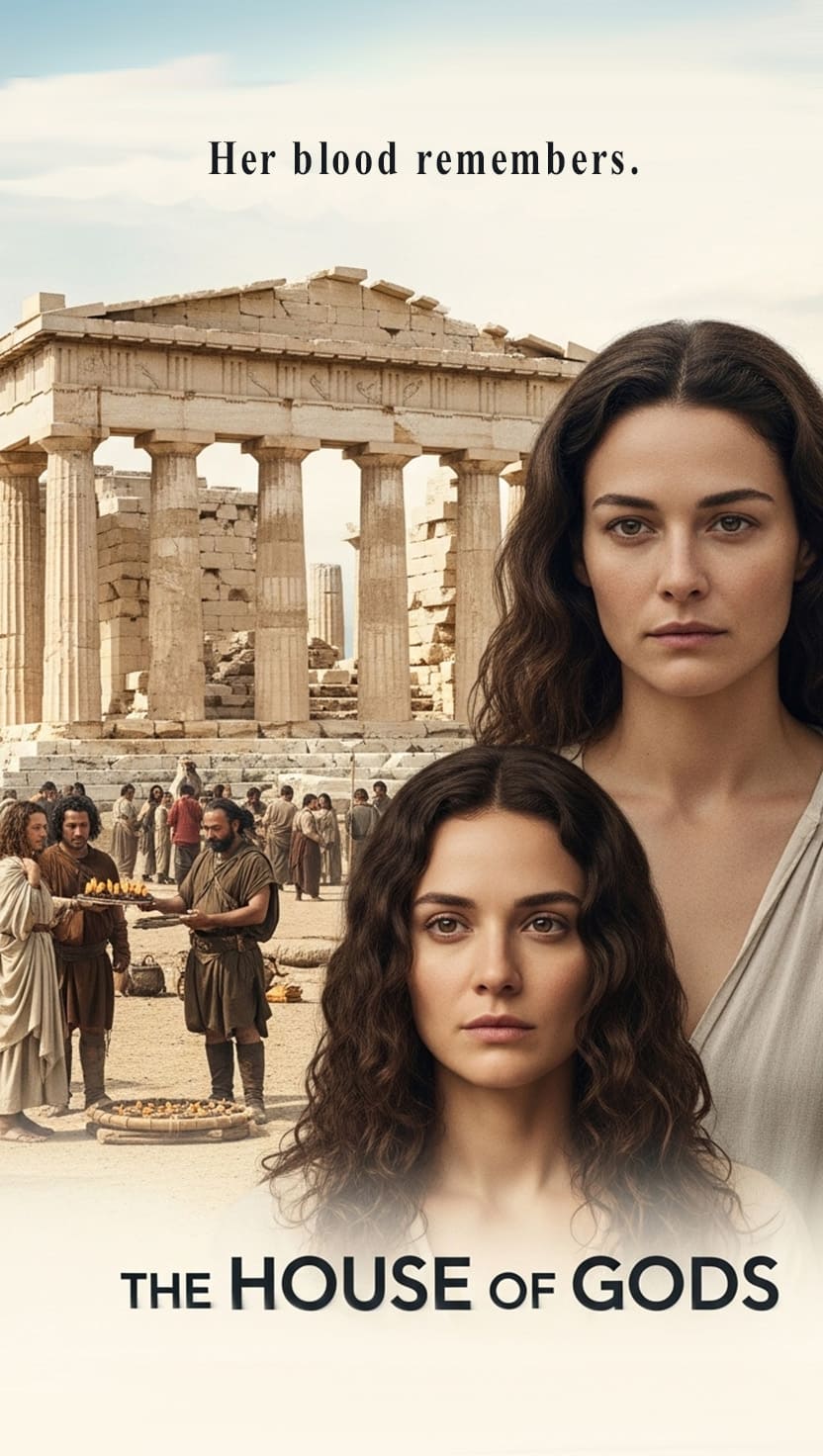
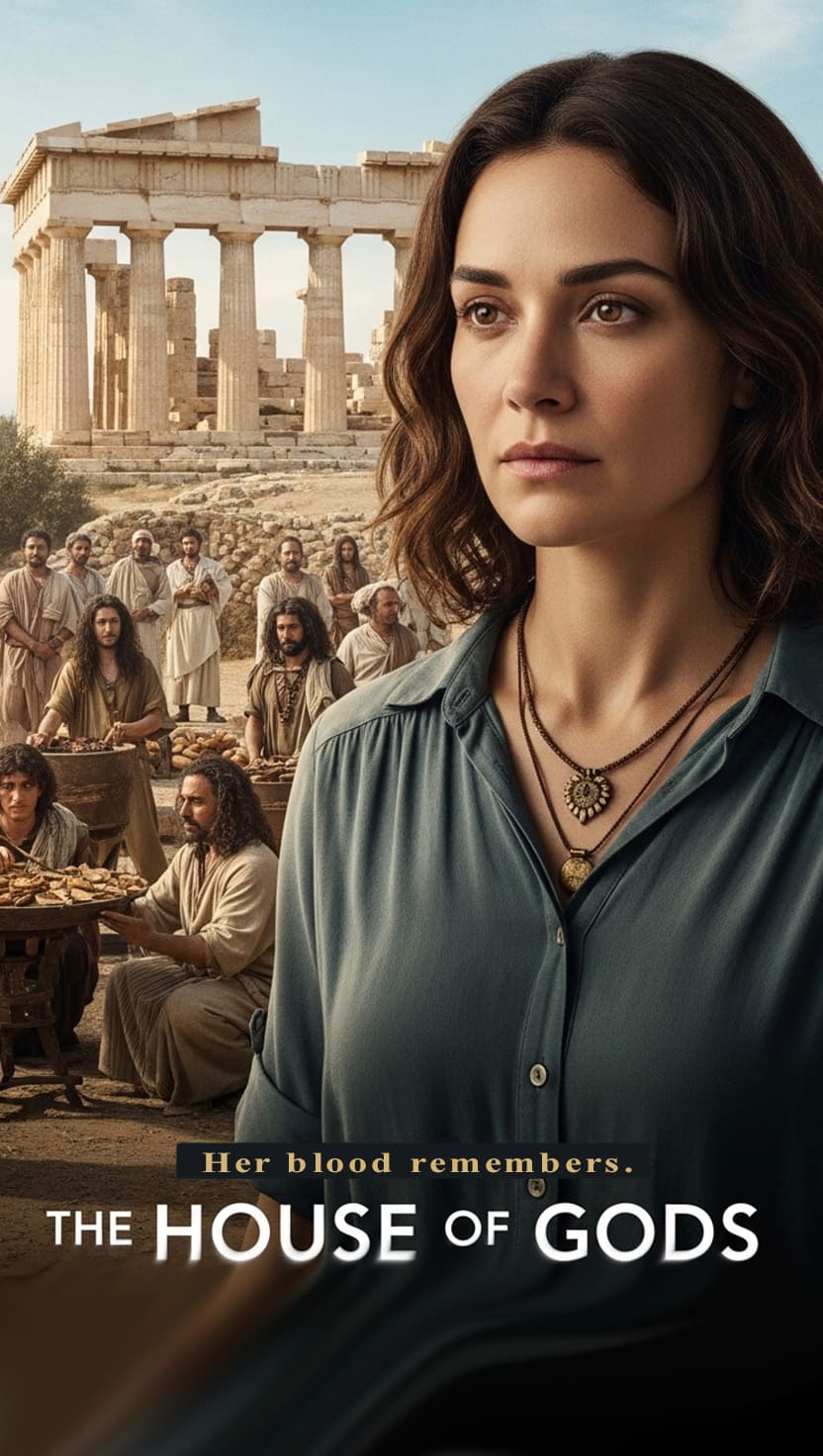
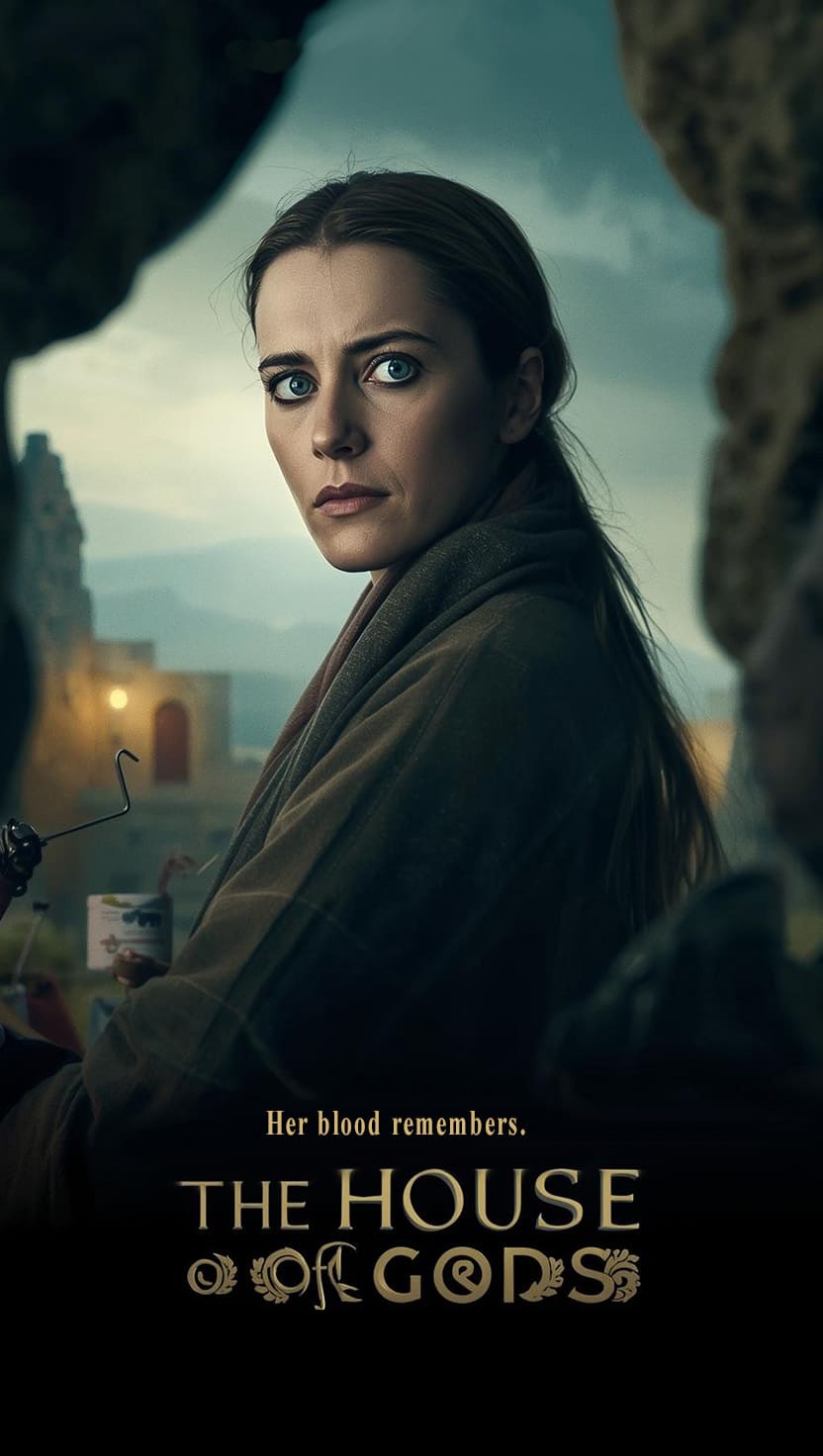
.jpg)
Comps
Comp #1 (Two Films):
It’s Ex Machina meets The Witch.
A cerebral, visually precise thriller where scientific pursuit and spiritual superstition collide — blending the cold, intellectual tension of Ex Machina with the folkloric dread and moral ambiguity of The Witch.
Comp #2 (Film + Genre Element):
It’s Hereditary with the metaphysical rigor of Arrival.
A psychological descent into inherited belief and engineered divinity — horror born not of demons, but of data, ritual, and the terrifying need to prove what should remain unknowable.
Comp #3 (Festival/Prestige Framing):
It’s Saint Maud reimagined as a mytho-scientific parable.
A claustrophobic, faith-obsessed character study elevated to a mythic scale — intimate, unsettling, and designed for the arthouse-meets-genre audience of A24, NEON, or MUBI.
Elevator Pitch:
She believes in data. He believes in Gods. And their blood might prove both are right.
In this haunting, cerebral thriller, a skeptical anthropologist returns to her remote Greek village for her mother’s funeral — only to discover her father’s secret experiment to scientifically prove divinity through human blood. As the rituals deepen and her own body becomes part of the data, she’s forced to confront the terrifying possibility that belief can be engineered… and that she may be the final proof.
Think Ex Machina meets The Witch — a mythic psychological thriller where faith, science, and inheritance collide in a chilling search for the divine.
Budget:
Mid-budget range for a prestige psychological thriller with contained locations and limited but stylized VFX.
Estimated Budget Category:$3M–$8M USD
This places The House of Gods alongside other elevated, auteur-driven genre films that merge arthouse tone with accessible thriller structure — ideal for a studio specialty division (A24, NEON, Searchlight) or a streamer seeking prestige horror.
Why This Budget Range Works:
Primary Costs:
Production Style:
Comparable Projects:
Special Studio Note:
If shot with a European co-production model (e.g., Greece/UK/Ireland), tax incentives and local funding could reduce the net cost, keeping it highly attractive for prestige distributors and genre festivals. I have specific contacts in Greece that can make this even more cost-effective.
Pitch Sheet:
Project Title: The House of Gods
Genre: Psychological Thriller / Supernatural Drama
Subgenres: Folk Horror · Mythic Science · Faith vs. Reason · Slow-Burn Psychological Descent
Tagline: When proof becomes worship, belief becomes deadly.
Elevator Pitch:
She believes in data. He believes in Gods. And their blood might prove both are right.
In this haunting, cerebral thriller, a skeptical anthropologist returns to her remote Greek mountain village for her mother’s funeral — only to discover her father’s secret experiment to scientifically prove divinity through human blood. As science and ritual fuse, her body becomes the final proof — forcing her to face the terrifying possibility that the Gods never died… they’ve simply evolved.
Think Ex Machina meets The Witch — a mythic psychological thriller where faith, science, and inheritance collide.
Tone & Vibe:
Lanthimos meets Garland — stark, ritualistic, and hypnotic.
A slow-burn descent into faith, obsession, and control, captured through precise, unsettling imagery and emotional restraint.
Visually austere, emotionally explosive — Saint Maud’s intimacy meets The Killing of a Sacred Deer’s surgical unease.
Logline:
In a remote Greek village where one family is said to carry the blood of the gods — descendants of Zeus himself — a skeptical anthropologist returns home for her mother’s funeral and discovers her father’s experiment to prove divinity through human blood. As the rituals deepen and belief infects reason, she becomes both observer and subject in a chilling collision between science and faith — and must decide whether to destroy her father’s creation, or surrender to it.
Concept:
Set in the decaying grandeur of a mountain estate turned laboratory, The House of Gods fuses psychological horror and mythic mystery into a meditation on faith, legacy, and control. Eleni, a rationalist anthropologist, returns home only to find her father’s “experiment” consuming the entire village — an attempt to resurrect divinity through blood resonance and human sacrifice. What begins as scientific curiosity becomes a ritual of contamination, where the dead hum beneath the floorboards and belief itself behaves like a virus. Blending metaphysical horror with emotional realism, the story asks what happens when the human need for certainty transforms science into religion — and turns daughter against father in the name of proof.
Plot:
When Eleni Hatzis returns to her ancestral village for her mother’s funeral, she uncovers her father Dimitrios’ clandestine experiments to measure “divine frequency” in human blood — a belief rooted in their family’s mythic lineage from Zeus. As she records his rituals for academic exposure, the results defy explanation: a young girl, Maria, seemingly resurrects, her pulse syncing perfectly with Eleni’s.
The deeper she investigates, the more the data bends toward faith — lights hum with prayer, blood glows beneath the skin, and logic dissolves. Dimitrios claims the gods are returning through her body; Eleni insists it’s manipulation. When the final experiment begins, she swaps the blood samples to destroy his proof — only for the resurrection to happen anyway.
In the aftermath, her father collapses, the villagers kneel, and Eleni’s own veins pulse with light. She escapes with Maria as dawn breaks, haunted by the truth: she may have destroyed the proof, but not the belief.
Comps:
Comp #1 (Two Films):
It’s Ex Machina meets The Witch.
A cerebral, character-driven thriller where faith and logic collide — blending sterile scientific precision with ancient dread and supernatural ambiguity.
Comp #2 (Film + Genre Element):
It’s Hereditary with the existential depth of Arrival.
A mythic, emotionally grounded horror about family legacy, obsession, and the cost of trying to define the divine.
Comp #3 (Festival/Prestige Framing):
It’s Saint Maud reimagined as a mytho-scientific parable.
A psychologically intimate descent into faith and contamination, crafted for audiences of A24, NEON, or MUBI.
Key Selling Points:
Primary Audience:
Fans of Ex Machina, Saint Maud, The Killing of a Sacred Deer, The Witch, Under the Skin, and Hereditary.
Ideal for streamers and distributors who thrive in elevated horror and psychological drama — A24, NEON, Searchlight, Netflix Prestige, Apple TV+ Originals.
Market Positioning:
A prestige psychological thriller designed for festival and streaming crossover — balancing arthouse tone with genre tension. Ideal for Venice, TIFF, Sundance, or Sitges programming. Built for audiences seeking smart horror with philosophical weight and visual minimalism.
Budget Category:
Mid-Budget ($3M–$8M USD)
Contained locations, intimate cast, and minimalist VFX with maximal visual control. Strong co-production potential (Greece/UK/Ireland). I have specific contacts in Greece that can make this even more cost-effective.
Lead Characters:
Eleni Hatzis (Lead, Female 30s) – A brilliant anthropologist whose devotion to logic becomes her undoing. She must decide if destroying belief means erasing herself.
Dimitrios Hatzis (Lead, Male 60s) – A scientist-priest obsessed with proving divinity through blood. His intellect masks a zealot’s need for control.
Maria (Supporting, Female 20s) – The vessel of the experiment; pure faith incarnate, caught between miracle and manipulation.
Petros (Supporting, Male 30s) – The loyal assistant torn between obedience and conscience, whose belief decays into horror.
Themes:
Why It Works for Big Studios or Streamers:
In One Line:
A chilling, mythic thriller where faith and science bleed together — and the search for proof awakens the gods buried in our blood.
Character Info:
Tailored for industry listings, pitch decks, and competition entries.
Character Profiles
Lead – Female, 30s. Analytical. Guarded.
Description:
Eleni is a brilliant anthropologist who dissects belief systems for a living — a skeptic armed with data, logic, and an unflinching gaze. Returning to her ancestral village for her mother’s funeral, she finds herself trapped inside her father’s secret experiment to scientifically prove divinity through human blood. Determined to expose his delusion, she instead becomes its vessel — her mind unraveling as science and faith collapse into one.
Character Type: Rational female lead haunted by legacy and belief; both scientist and potential saint.
Think: Alicia Vikander in Ex Machina meets Florence Pugh in Midsommar.
Arc: Eleni begins as an observer who believes she’s immune to myth. By the end, she’s transformed — contaminated by faith, yet empowered through surrender — embodying the terrifying truth that logic and devotion can share the same pulse.
Casting Notes: Demands an actress capable of stillness, quiet unraveling, and emotional precision — a performance that can shift from detached intellect to transcendental fear without losing control.
Lead – Male, 60s. Charismatic. Fanatical.
Description:
A former theologian turned scientist, Dimitrios has dedicated his life to bridging the gap between faith and evidence. To him, belief is data waiting to be measured — and the body, a divine instrument of proof. He exudes calm, almost priestly authority, masking his mania beneath precision and grace. He believes his daughter is the key to his experiment — and the proof of God’s endurance through blood.
Character Type: Intellectual antagonist driven by faith disguised as reason — a scientist-priest archetype.
Think: Christoph Waltz in The Zero Theorem meets Ethan Hawke in First Reformed.
Arc: Begins as the confident architect of divine proof and ends as its final subject — a man undone by his need for certainty, collapsing into worship of his own creation.
Casting Notes: Requires an actor who can balance gentleness and menace, capable of turning quiet conviction into horror.
Supporting – Female, Late Teens to Early 20s. Innocent. Devout.
Description:
A young village woman chosen as the vessel for Dimitrios’ experiment, Maria’s purity is both literal and symbolic. She believes her suffering has meaning — that her blood carries the voice of the gods. Torn between awe and fear, she becomes the human bridge between Eleni’s logic and Dimitrios’ faith.
Character Type: Tragic innocent transformed into living myth; the believer caught in the crossfire between science and salvation.
Think: Anya Taylor-Joy in The Witch meets Raffey Cassidy in Vox Lux.
Arc: Begins as a submissive participant in ritual and ends as an ambiguous survivor — faith stripped bare, identity dissolved, but humanity flickering through the cracks.
Casting Notes: Needs an actress with fragile, magnetic presence — someone who can shift from terrified child to divine icon with one expression.
Supporting – Male, 30s. Loyal. Torn.
Description:
The devoted assistant and surrogate son to Dimitrios, Petros embodies the village’s collective faith — obedient, faithful, yet secretly fearful of what they worship. His allegiance fractures as he witnesses the experiment’s descent into fanaticism. He is the story’s moral mirror — proof that devotion can destroy as much as it redeems.
Character Type: Conflicted disciple — the believer forced to face doubt.
Think: Barry Keoghan in The Killing of a Sacred Deer meets Caleb Landry Jones in Get Out.
Arc: Begins as a loyal follower, ends as a man stripped of belief — realizing too late that his obedience made the horror possible.
Casting Notes: Ideal for an actor who can convey innocence corrupted by faith; quiet emotional breakdowns under the surface of ritual restraint.
Supporting – Female, 70s. Matriarchal. Cryptic.
Description:
The elder of the village — part seer, part scientist’s nursemaid. Agatha remembers the old ways and recognizes the danger in Dimitrios’ pursuit. She serves as a quiet warning that the gods demand balance, not proof.
Character Type: Oracle archetype rooted in realism; voice of ancestral caution.
Think: Charlotte Rampling in Dune meets Juliette Binoche in The Truth.
Arc: Her faith survives the ordeal, but her silence makes her complicit — a relic of tradition watching its mutation.
Casting Notes: Requires a performer with gravitas, mystery, and emotional restraint — someone whose presence alone feels mythic.
Summary Character Dynamic:
Eleni and Dimitrios form the core collision — a daughter who worships reason and a father who worships proof. Maria and Petros serve as reflections of belief: one pure, one corrupted. Together, they form a living equation of devotion, science, and inheritance — the house of gods built on blood.
Script:
This document is view-only for content protection.
If you’d like a personal copy to read, please email me at info@melogia.com
Follow Sarantos: